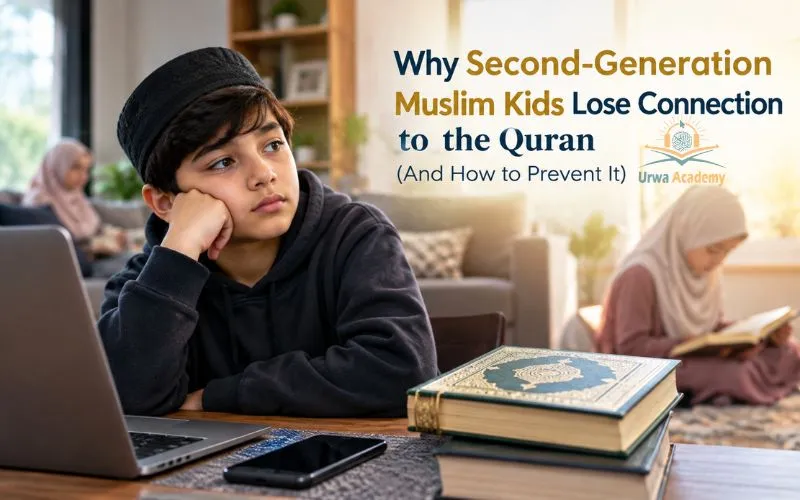
Second-generation Muslim kids growing up in the West don’t usually lose connection to the Quran because of one dramatic moment. It tends to happen quietly, through years of Quran class feeling disconnected from the rest of their life — something memorized for a certificate rather than something that actually means anything to them day to day. The good news is that researchers who study Muslim American youth have identified specific, practical things that make a real difference, and most of them are things a family can start doing at home, not just in the classroom.
The “In-Between” Feeling Is Real, and It’s Normal
Researchers who study Muslim youth identity in the West use a specific term for something many second-generation kids describe: being “in-between.” Not fully at home in the culture their parents grew up in, and not fully at home in the Western culture they’re raised in either. This isn’t a sign that something has gone wrong in how a child was raised. It’s a genuinely common experience documented across studies of Muslim American youth, and understanding it changes how you can respond to it.
A child who feels caught between two worlds isn’t rejecting Islam when they seem disengaged from Quran class. Often, they’re struggling to see how it connects to the actual life they’re living — school, friendships, sports, everything else that fills their week.
What the Research Actually Shows Helps
This is the part most families never hear about, because it doesn’t get discussed much outside academic research. A few consistent findings stand out:
Family conversations about faith matter more than formal instruction alone. Researchers studying religious development in Muslim youth have found that ongoing, natural conversations at home about what faith means — not lectures, just genuine conversation — play a meaningful role in how young people’s religious identity develops. A child who only encounters Islam in a formal classroom setting, without it ever coming up naturally at home, tends to experience it as a subject rather than a part of who they are.
Identity, not just knowledge, is what’s actually at stake. Studies on Muslim American youth describe religious identity as something that develops alongside ethnic and national identity, not separately from it. A child navigating “how Muslim am I, how American am I, how much does my family’s background matter” is doing real identity work — and Quran education that ignores this entirely, treating the goal as pure memorization, misses what’s actually going on for the child.
The generational religiosity gap is real, but smaller than people assume. Global research on religion finds that younger Muslims are, on average, only modestly less likely than older generations to say religion is very important to them, a much smaller generational gap than seen in many other religious traditions. This matters because it means the disconnect many parents worry about isn’t inevitable or automatic. It’s shaped heavily by how faith is presented and experienced growing up, not something that simply happens with age.
What This Means for How Quran Classes Should Actually Work
Given what the research points to, a few things follow directly:
Meaning has to be part of the class, not an afterthought. A child who only ever recites without understanding what they’re reciting is being taught a skill, not a connection. Weaving in what a verse actually means, even briefly, changes what the class is doing for a child’s sense of identity.
Real-life relevance matters, especially for teens. A teenager navigating peer pressure, friendships, or difficult choices benefits far more from a teacher who can connect a Surah to something they’re actually facing than from recitation alone. This is part of why we build Islamic Studies alongside pure recitation into how we teach older kids and teens, not as a separate, disconnected subject.
The class shouldn’t be the only place faith comes up. Since family conversation matters as much as formal instruction, a good academy should feel like it’s supporting what happens at home, not replacing the need for it. Parents don’t need to have all the answers themselves — but a class that occasionally gives families something worth talking about together does more than one that treats Quran learning as fully separate from home life.
Consistency matters more than intensity. A rushed, cram-focused approach to memorization or reading, without room for genuine engagement, tends to produce short-term results and long-term disengagement. Slower, steadier learning that a child actually connects with tends to last.
A Different Way to Think About the Goal
If the only goal of Quran class is correct recitation, a child can technically succeed and still walk away feeling nothing for it. The research on Muslim youth identity suggests the real goal is broader: helping a child build a genuine sense of who they are, with their faith as something integrated into that, not separated from the rest of their life.
That’s a harder thing to measure than a completed Surah, but it’s the difference between a child who quietly drifts away as a teenager and one who carries what they learned into adulthood.
Frequently Asked Questions
Is it normal for my teenager to seem disengaged from Quran class? Yes, this is common, and it usually reflects the “in-between” identity experience researchers have documented in Muslim youth, rather than genuine rejection of faith. How a teacher and family respond to this disengagement matters more than the disengagement itself.
Does moving to a Western country make it inevitable that my kids will drift from Islam? No. Research shows the generational gap in religiosity among Muslims is relatively modest compared to other religious traditions. How faith is presented, discussed at home, and connected to real life plays a bigger role than simply growing up in a Western country.
Should I talk to my kids about faith outside of formal Quran class? Yes. Research consistently points to natural family conversation about faith as playing an important role in how children’s religious identity develops, separate from and alongside formal religious education.
How can I tell if my child’s Quran class is helping with more than just recitation skills? A good sign is whether meaning and real-life relevance come up naturally in lessons, not just correction of pronunciation. Ask your child what a recent lesson was actually about, not just what Surah they practiced.
Want Quran classes online that connect meaning to your child’s real life, not just recitation? Book a free trial class and see how we approach this with kids and teens.