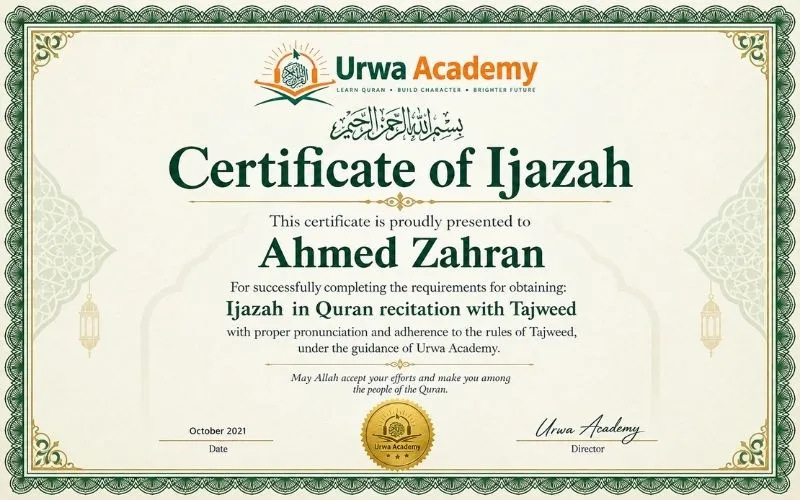
An ijazah in the Quran is a teacher’s written or spoken permission to teach the Quran, given by someone who personally heard that student recite and who was given the same permission by their own teacher. Behind it sits a chain of teachers, called a sanad, and that chain runs link by link back to the Prophet ﷺ. So an ijazah isn’t a school diploma. It’s closer to a handshake that has been passed down for over fourteen centuries.
If you’ve seen the word on a tutor’s profile and wondered whether it matters, this post explains what it is, how people earn one, what it can’t tell you, and how to ask about it without feeling awkward.
What does “ijazah” actually mean?
Ijazah is the Arabic word for “permission.” In Islamic learning, it means a qualified teacher is authorizing a student to pass on what they’ve learned. The idea isn’t limited to the Quran. Scholars of hadith, fiqh and other subjects have used ijazahs for centuries, and the practice was personal from the start: a student travelled to a teacher, studied with them, and left with their permission to transmit.
For the Quran, that permission means something specific. The teacher has listened to you recite, checked your recitation against what they received from their own teacher, and is satisfied that you can pass it on accurately.
What is a sanad, and how is it different?
The sanad is the chain of names. Your teacher’s name, then their teacher’s, then theirs, going back through generations of reciters to the Companions and finally to the Prophet ﷺ.
The two words get used as if they mean the same thing, but they’re not identical:
- Ijazah is the permission.
- Sanad is the chain that permission belongs to.
A real Quran ijazah usually comes with a sanad. But the reverse can fail. Some institutions hand out a certificate of completion and call it an ijazah, with no chain attached. That’s a course certificate, which is fine for what it is, but it isn’t the traditional thing.
Why did Muslims build the Quran’s teaching around a chain?
Because that’s how the Quran was first taught. According to the narration in Sahih al-Bukhari, Jibril (peace be upon him) reviewed the Quran with the Prophet ﷺ every Ramadan, and twice in the year he passed away. The Companions then learned by listening and reciting back, face to face, and corrected one another. They didn’t learn from a printed page. They learned from a person.
That habit never changed. Even today, a teacher in a tradition of ijazah will say that you can’t fully learn recitation from a book, because a book can’t hear you. It can’t tell you your qaaf is sitting too far forward in your mouth. A person can.
What are qira’at and riwayat? (And why does your ijazah name one?)
Here’s a detail that surprises many people. An ijazah isn’t for “the Quran” in general. It’s for the Quran as recited in a specific way.
There are ten recognized recitations, called qira’at, each named after a leading reciter, such as Nafi’, ‘Asim, or Abu ‘Amr. Each of these is passed down through narrators, and each narrator’s version is called a riwayah. They are all the same Quran, read with small, authentic differences in things like vowel patterns or pronunciation. They aren’t different books.
The one most Muslims around the world know is Hafs ‘an ‘Asim. Hafs ibn Sulayman (d. 180 AH / 796 CE) transmitted it from ‘Asim ibn Abi al-Najud, who took it from Abu ‘Abd al-Rahman al-Sulami, who took it from Companions including ‘Uthman, ‘Ali, Ubayy ibn Ka’b, Ibn Mas’ud and Zayd ibn Thabit. In North and West Africa, many Muslims recite Warsh ‘an Nafi’ instead.
So if a tutor tells you they hold an ijazah, a fair follow-up is: “In which riwayah?” For most families in the UK, USA, Canada and Australia, the answer will be Hafs ‘an ‘Asim, and that’s the one your child’s Mushaf is almost certainly printed in.
What makes a recitation “authentic” in the first place?
Scholars needed a way to tell sound readings from invented ones. The standard that most people cite comes from Ibn al-Jazari (751–833 AH), the Damascus-born scholar often called the great authority on the ten qira’at. He set three conditions. A reading is accepted only if:
- It has an authentic, unbroken chain back to the Prophet ﷺ.
- It fits the script of the ‘Uthmani Mushaf.
- It agrees with the rules of classical Arabic.
If a reading fails any one of the three, it isn’t accepted as a Quranic recitation. That’s a strict filter, and it’s the reason an ijazah leans so heavily on the chain.
How do people earn an ijazah in the Quran?
The details vary from teacher to teacher, but the usual path looks like this.
1. Build the foundation. You need to read Arabic fluently, and your Tajweed has to be clean. Teachers don’t tend to take on someone still fumbling through letter shapes.
2. Find a teacher who holds an ijazah in the riwayah you want. This part matters. A teacher can only pass on what they were given. If their own ijazah doesn’t cover the riwayah, they can’t grant yours.
3. Recite the whole Quran to them. From Al-Fatihah to An-Nas, in front of the teacher, who listens and corrects. This is the heart of it, and it’s not a quick exam. It can stretch over months of regular sessions, sometimes longer.
4. Receive the ijazah. When the teacher is satisfied, they give you permission, and your name is added to the end of the chain.
Do you have to be a Hafiz first?
This is where different teachers disagree, so it’s worth being clear about it rather than pretending there’s one rule.
Some teachers require you to recite the entire Quran from memory before they’ll give an ijazah. Others grant an ijazah in recitation to a student who reads the whole Quran from the Mushaf, with full accuracy and correct Tajweed. There’s also a separate path, an ijazah in Tajweed, where the student studies a foundational text such as al-Muqaddimah al-Jazariyyah and proves they understand it.
If you’re thinking about an ijazah for yourself or your child, ask the teacher which kind they offer and what they require. It’s a normal question, and a good teacher will answer it plainly.
How long does it take?
Nobody can give you an honest single number. The published estimates are all over the place, because it depends on where you start, how often you study, and how strict your teacher is. A student with strong Tajweed and fluent reading who studies several times a week is on a very different timeline from a beginner. The fair summary is this: it’s measured in years for most people, and it moves at the speed of accuracy, not the speed of the calendar. If anyone promises you an ijazah in a fixed number of weeks, take that as a warning sign.
Can you earn an ijazah online?
Yes, many teachers conduct ijazah sessions over video, and this has become common. What matters is that the teacher can hear your recitation clearly and that they hold a real, traceable chain themselves. Some teachers still prefer to do the final recitation in person, so it’s worth asking what your particular teacher expects. Neither approach is a trick. They’re two ways of doing the same careful listening.
Can women earn an ijazah?
Yes. Ijazah has never been restricted by gender, age or background. Women have studied, earned and granted ijazahs throughout Islamic history. If you’re looking for a female teacher for yourself or your daughter, asking whether she holds an ijazah is as reasonable as it is for any male teacher.
What an ijazah can’t tell you
This is the part most articles skip, and it’s the part parents most need.
An ijazah tells you that someone’s recitation was checked and that they’re a link in the chain. It does not tell you:
- Whether they can teach children. Reciting beautifully and teaching a restless six-year-old are two separate skills. Plenty of excellent reciters aren’t patient teachers.
- Whether they’re right for your child. Temperament, warmth and communication matter a great deal, especially for young learners.
- How much experience they have. A teacher who received an ijazah last month and one who has taught for twenty years can both hold the same piece of paper.
So think of an ijazah as strong evidence of one thing, which is accurate recitation, rather than proof of everything. The rest you only learn by watching them teach.
Do you or your child need an ijazah to learn the Quran?
No. Students don’t need one to learn, read, memorize or benefit from the Quran. An ijazah is for people who want to transmit the Quran as teachers, in the same tradition they received it. A child learning Noorani Qaida needs a patient, accurate teacher, not a certificate of their own.
What you do want is that your teacher’s recitation is correct, because small mistakes taught early tend to stay. That’s the real reason the question matters.
How to ask a Quran teacher about their ijazah
You don’t need to interrogate anyone. A few polite questions are enough:
- “Who did you study recitation with?”
- “Do you hold an ijazah, and in which riwayah?”
- “Is it a full ijazah with a chain, or a course certificate?”
- “Could you tell me the names of the first few teachers in your sanad?”
A teacher who truly holds one will usually be glad you asked. Many are proud of their chain and can name it. Be a little cautious if someone gets defensive, offers a certificate with no named scholars on it, or claims an ijazah without being able to say who gave it.
Then, separately, book a trial class and watch the teaching. The certificate answers “can they recite?” The trial answers “can they teach my child?”
Where does Urwa Academy fit in?
An ijazah is one way of judging a tutor’s recitation. Whatever certificate a tutor holds, we don’t ask families to rely on paper alone. At Urwa Academy, every tutor must be a Hafiz or Hafizah, has their Tajweed assessed directly, and goes through months of training in how to teach before meeting a single student. You can read the full process in How We Vet Our Quran Tutors.
If you’re still weighing up what to look for, our guide on how to choose a safe, qualified online Quran teacher walks through the practical checklist. And if memorization is your goal, our Quran memorization course is where that journey starts, with a free trial class so you can hear the teacher yourself.
Frequently Asked Questions
What does ijazah mean in the Quran? Ijazah is Arabic for “permission.” In Quran learning, it’s a qualified teacher’s authorization for a student to teach the Quran, given after the teacher has heard the student recite and confirmed their accuracy. It is linked to a chain of teachers, called a sanad, that goes back to the Prophet ﷺ.
What is the difference between ijazah and sanad? The ijazah is the permission itself. The sanad is the chain of teachers that the permission belongs to. A traditional Quran ijazah comes with a sanad, but some certificates called “ijazah” are only course completion certificates and carry no chain.
Is an ijazah required to teach the Quran? Teaching the Quran doesn’t have a single legal requirement in every setting, but an ijazah is the traditional mark that a teacher’s recitation was checked and authorized by a qualified teacher. Many families treat it as a strong sign of accurate recitation, while also checking how well the person actually teaches.
Can you get an ijazah in the Quran online? Yes. Many teachers hold ijazah sessions over video, as long as they can clearly hear the recitation and hold a genuine chain themselves. Some teachers prefer the final recitation in person, so it’s worth asking what they expect.
Do I need to memorize the whole Quran to get an ijazah? It depends on the teacher and the type of ijazah. Some require the whole Quran recited from memory; others grant an ijazah in recitation for reading the entire Quran accurately from the Mushaf, and there is also a separate ijazah in Tajweed based on a foundational text. Ask the teacher which one they offer.
Does my child’s Quran teacher need an ijazah? It’s a good sign, but not the only one. An ijazah shows accurate recitation, while patience, clear explanation and experience with children are things you check separately, ideally in a trial class.