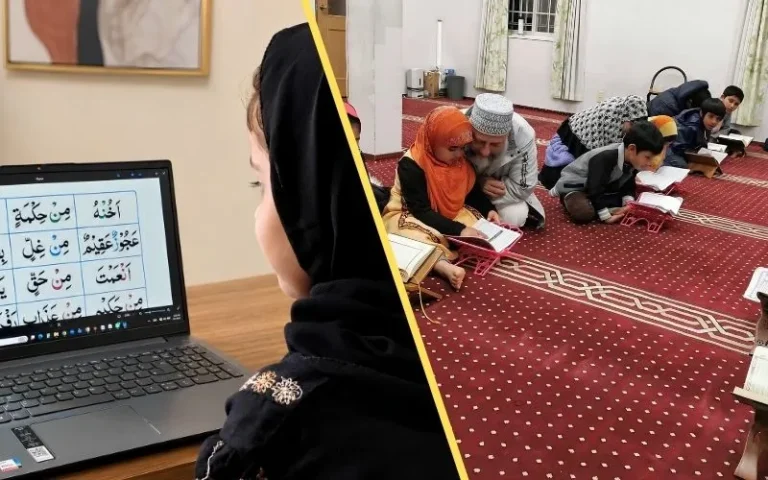
A good first Quran lesson does three things in about half an hour. The teacher finds out where your child actually is, teaches one small thing to see how your child learns, and ends by telling you plainly what the plan is. It is not a full recitation, a long lecture, or a sales pitch. If you walk away knowing your child’s starting point and the next step, it did its job.
That sounds simple, but most parents have no idea what to expect, so they sit there wondering whether it’s going well. Here’s what a first lesson should look like, and the signs that something’s off.
How long is a first Quran lesson?
Most first lessons run somewhere between 20 and 45 minutes, and about 30 is a common length. That’s long enough to listen to your child read and teach a small point. It’s short enough that a young child doesn’t melt down halfway through.
Length matters more than people think. A rule of thumb that teachers and child-development writers often repeat is that a child can focus for roughly two to five minutes per year of age. It’s a rough guide, not a law, and it shifts with sleep, hunger and mood. But it explains why a seven-year-old can’t sit still for an hour of Arabic letters, and why a good teacher breaks the lesson into short pieces.
What actually happens, step by step
Different teachers run things differently, but a solid first lesson usually follows this shape.
1. A short hello (first 3 to 5 minutes)
The teacher introduces themselves and asks a few easy questions. How old is your child? Have they read any Arabic before? Do they know any surahs by heart? What are you hoping for?
Don’t underestimate this part. Children relax when a teacher sounds like a person and not an examiner. A child who feels safe will try to read. A child who feels tested will go quiet.
2. Finding the starting point
Next comes the part that really matters. The teacher listens to your child read, and the question is “where are they right now?” There are no marks and no passing grade.
What the teacher checks depends on the child:
- A true beginner: can they recognize the Arabic letters? Do they know the sounds?
- A child who has read before: can they join letters into words, and how smoothly do they read?
- A more advanced reader: how is their pronunciation, and do they apply basic Tajweed rules such as lengthening (madd), nasal sounds (ghunnah) or the bounce on certain letters (qalqalah)?
- Any child: how confident do they seem reading aloud?
If a child is brand new to reading, the teacher will usually open the Noorani Qaida, the beginner book that starts with the 28 letters of the Arabic alphabet and builds up through short vowels, joined letters and basic rules. (If you’re curious what that path involves, our Noorani Qaida course explains it.)
3. One small lesson
Now the teacher teaches one thing, just one. It might be how a single letter is pronounced, one Tajweed rule, or a short, familiar surah.
This isn’t about covering ground. It’s a test drive. The teacher is watching how your child responds to correction. Do they try again? Do they freeze? Do they get it faster when they hear it, or when they see it? That tells the teacher how to teach this particular child.
4. A plain summary at the end
In the last few minutes, the teacher should tell you what they noticed: what your child does well, what needs work, and where they’d start. You should also hear what kind of schedule they’d suggest and how often lessons would happen.
You’re not owed a polished report. You are owed a straight answer.
What a good teacher’s correction sounds like
This is the single most useful thing to watch, so it’s worth slowing down on.
When your child makes a mistake, a good teacher will usually:
- Pick the most serious mistake and fix that one, instead of listing five at once.
- Say what went wrong and how to fix it (“this letter comes from further back in the throat”), not just “wrong.”
- Let your child try again straight away.
- Stay calm and kind, with no sarcasm and no sighing.
If a teacher keeps saying “no, again” with no explanation, your child is being asked to guess, and guessing isn’t learning.
What should the parent do during the lesson?
Less than you’d think. Here’s what tends to work:
- Before: Check the camera, microphone and internet, and have the Mushaf or Qaida and a notebook ready. Pick a time when your child is fed and rested, not rushing in from football. Tell them the teacher is there to help, not to grade them.
- During: Stay nearby, but stay quiet. Don’t answer for your child or correct them mid-sentence. The teacher needs to hear what your child can really do, not what you can do. Step in only for technical trouble.
- Notice: Is your child comfortable enough to make a mistake? That’s a good sign. Do they seem to understand the instructions? Does their attention drop at a certain point? That tells you what lesson length suits them.
What a first lesson is not
It’s easier to spot a bad first lesson when you know what it shouldn’t be:
- Not a performance. Your child doesn’t need to know anything yet. Starting from zero is completely fine.
- Not a marathon. If it runs well past an hour, a young child is probably checked out and learning nothing.
- Not a lecture. If the teacher talks for most of it and barely hears your child read, nobody has been assessed.
- Not a pressure moment. You shouldn’t be pushed to pay or sign up on the spot.
Red flags in a first lesson
Be cautious if you notice any of these:
- No real assessment. The teacher recommends a course without ever listening to your child read.
- Vague or harsh correction. Repeated “wrong” with no explanation, or any shaming.
- Big promises. “Your child will finish the Quran in six months” is a claim nobody can responsibly make before knowing the child.
- Sales pressure. “Today only” offers, or discouragement from taking time to decide.
- No clear plan. You leave without knowing your child’s level, the first priority, or what happens next.
- Unclear who the teacher is. You can’t tell who they are, how they were trained, or who to talk to with a concern.
If you want a longer checklist beyond the first lesson, our guide to choosing a safe, qualified Quran teacher covers what to check before you commit.
What to do after the first lesson
Write down what you noticed while it’s fresh. Then ask your child three simple questions: What was easy? What was hard? Did you like the teacher? Children are usually more honest than adults expect.
Before you decide, it helps to know:
- What level the teacher placed your child at, and why.
- What the first thing to work on would be.
- How long each lesson would be, and how often.
- What practice is expected at home.
- Whether the teacher you met is the one who would teach your child regularly.
- When you’d review progress, since four to eight weeks in is a sensible point to check.
If you’re trying more than one teacher, compare them using the same questions, not by who sounded the most polished.
Does the teacher’s background matter at this stage?
It does. A calm, kind manner is great, but the teacher’s own recitation has to be accurate too, because anything wrong taught early tends to stick. That’s why we explain exactly how every tutor is checked in How We Vet Our Quran Tutors. And if your child can’t yet read Arabic letters, the first step is usually learning to read, which is what our guide to learning to read the Quran walks through.
Frequently Asked Questions
How long is a first Quran lesson? Most run between 20 and 45 minutes, and around 30 minutes is common. Younger children do better with shorter, more varied lessons because their attention spans are shorter.
What does a teacher check in a first Quran lesson? For a beginner, they check whether the child recognizes Arabic letters and their sounds. For a child who already reads, they check how smoothly they join letters, how accurate their pronunciation is, and whether they apply basic Tajweed rules. They also notice confidence and how the child responds to correction.
Should I stay in the room during my child’s first lesson? Yes, stay nearby, especially with younger children, but stay quiet. Let the teacher hear what your child can do without help. Step in only for technical problems.
Does my child need to know any Arabic before the first lesson? No. A first lesson is meant to find out where your child is, including if they are starting from zero. Teachers expect beginners.
What should a parent ask after the first lesson? Ask what level your child was placed at, what the first priority is, how long and how often lessons would be, what practice to do at home, and whether the same teacher would continue. Also ask when progress would first be reviewed.
What are warning signs in a first Quran lesson? Watch for no real assessment, correction with no explanation, shaming or sarcasm, promises of finishing within a fixed time, pressure to sign up immediately, and no clear plan at the end.
You can join our Online Quran Classes program with 3 days free trial classes, Insha Allah you will be satisfied 100% with our male and female Quran tutors.