


A young child’s focus in a Quran lesson depends on three things more than on the child’s character: how the lesson is built, the state their body is in, and what’s around them on the screen. Fix those, and most “he just won’t concentrate” problems shrink. A child who drifts off at minute twelve isn’t being difficult. Usually the lesson has simply run past what that child can hold on that day.
That’s good news, because lesson design, sleep, and setup are all things a parent can change. Here’s how.
What’s a normal amount of focus for a young child?
Less than most adults expect. A rough rule that clinicians and teachers often repeat is that a child can concentrate for about two to five minutes per year of age on a task someone else chose. It isn’t a hard law, and nobody has pinned it to one clean study. But it matches what any parent sees: a five-year-old might manage ten to twenty-odd minutes of real effort on a good day, and that’s a ceiling, not a target.
Two things shift that number a lot. One is the day itself: sleep, hunger, mood. The other is the task. A child who can build Lego for an hour may last five minutes on letter sounds. Both are normal.
So the first rule is to stop asking “why can’t my child focus for an hour?” and start asking “is this lesson the right size for this child?”
Does it matter that the lesson is on a screen?
It does, a little, and in an interesting way.
In a 2016 study from Lafayette College in Pennsylvania, researchers worked with 60 toddlers aged one to two. For a week, half the children had live video chats with a partner who taught them new words and patterns, and the other half watched pre-recorded videos of the same kind of teaching. Both groups paid attention. But only the children who talked with a live partner, who could see and respond to them, learned from it.
Be careful with this one. The children were toddlers, the groups were small, and it lasted a week. It wasn’t about Quran lessons. But it supports something teachers already know: on a screen, a child learns when someone is responding to them, not when something is merely playing at them.
For you, that means a good video lesson should feel like a conversation, with the teacher listening, reacting, asking the child to try. If the teacher talks for most of the session and your child watches, it’s closer to the pre-recorded video, and attention will fade fast.
Start before the lesson: sleep, food, and a gap
The cheapest focus tool is also the most boring. Sleep.
The American Academy of Sleep Medicine’s consensus recommendation, which the American Academy of Pediatrics has endorsed, is 10 to 13 hours a day for children aged 3 to 5, and 9 to 12 hours for ages 6 to 12 (naps count for the younger ones). A child running short on sleep can’t hold attention, however good the teacher is.
Then think about the 30 minutes before the lesson:
- Don’t schedule it straight after school or a busy activity. Give them a gap.
- Make sure they’ve eaten something. A hungry child is a distracted child.
- Add a small ritual. Making wudu, drinking some water, and sitting quietly for a minute works well as a “we’re starting now” signal. Children like routines that tell their body what’s coming.
Set up the space so there’s only one thing to look at
Screens are crowded places. Your job is to shrink the crowd.
- One tab, one app. Close games, other tabs, and chat windows. Switch off notifications, because a pop-up will beat any teacher.
- A quiet desk, with only what’s needed. The Mushaf or Qaida, a notebook, a glass of water. Clear the rest.
- Camera and screen where they can see both teacher and book. If your child has to twist around, they’ll lose the thread.
- Good light on the page, no glare.
- A plan for siblings. A quiet activity for them, or another room.
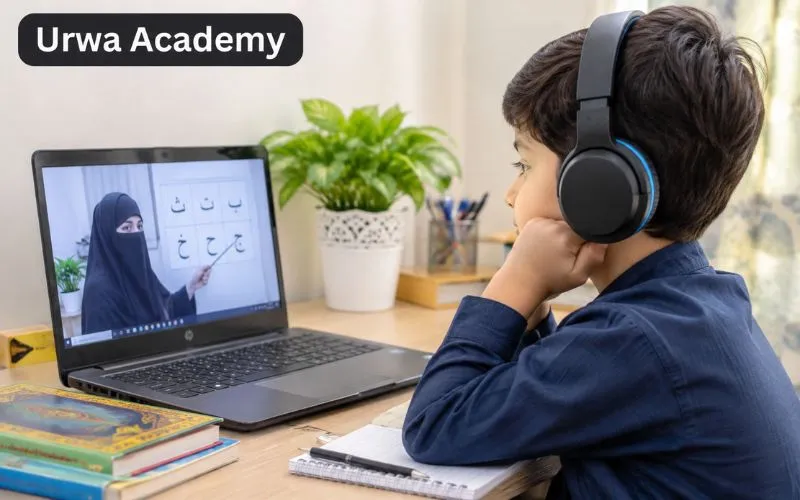
- Headphones if the room is noisy. They also help your child hear the teacher’s pronunciation clearly, which matters a lot in recitation.
A physical Mushaf or Qaida in hand is worth having even if you could use a tablet. A second screen is a second place to wander.
What the lesson itself should look like
This is the teacher’s side, but parents can recognize good practice when they see it.
A well-run lesson for a young child usually:
- Has one goal. One line, one letter, one rule. Not five.
- Changes activity often. Listen, repeat, point, read alone, answer a question, repeat again.
- Lets the child try first. The teacher waits a moment before jumping in. Thinking time is learning time.
- Corrects the smallest useful piece. If a child slips on one word, the teacher fixes that word and moves on, instead of restarting the entire passage and draining everyone.
- Keeps instructions short. One instruction at a time.
- Praises effort that’s specific: “I liked how you tried that letter again” works better than a generic “good job.”
Here’s an example, not a rule, of how a 20-minute lesson for a young child could be shaped: a short hello and warm-up, a quick review of last time, one new thing taught, guided practice, the child trying it alone, and a calm close with praise and a small goal for home. Notice that it changes every few minutes.
The way a teacher handles all this is why we put so much weight on teaching skill, not just recitation. Every tutor at Urwa Academy goes through months of training on how to engage students of different ages before taking a class, which you can read about in How We Vet Our Quran Tutors.
Short resets help (and what they shouldn’t become)
Many teachers build in tiny resets: a sip of water, sitting up tall, a stretch, or reciting one line standing up. They take thirty seconds and give a young body somewhere to put its wiggles.
A few ground rules:
- Reset before your child fully checks out, not after.
- Keep it quick. It’s a pause, not a play session.
- Watch the frequency. If you need a reset every few minutes, the problem isn’t the child. The lesson is probably too long, too hard, or at the wrong time of day.
Your job as the parent: be there, but don’t take over
The hardest part for many parents is staying quiet.
- Before the lesson, open the link and the right page so your child isn’t wasting their best minutes on setup.
- During the lesson, sit nearby, especially for the youngest. If your child freezes, give the least help that gets them going again. A smile and a nod is often enough.
- Don’t answer for your child, and don’t repeat every instruction. The teacher needs to hear what your child actually does.
- Praise effort you actually saw: “You tried that letter three times!”
- If something worries you, talk to the teacher privately afterwards, not in front of your child.
What your child’s behavior is telling you
Think of distraction as a message. Here’s a rough decoder:
| What you see | What it might mean |
|---|---|
| Looks away late in the lesson | The lesson is too long for them right now |
| Guesses, or avoids trying | The material may be a bit too hard |
| Struggles only with one kind of task | That specific skill needs smaller steps |
| Needs you to keep them going | The pace, timing or style isn’t a fit |
| Restless at the same point every time | Move the hardest work earlier, or shorten the lesson |
If your child is a beginner and struggling because they can’t yet read Arabic letters, the answer may be starting at the right place. The Noorani Qaida is designed for exactly that. And if you’re wondering whether they’re ready for memorization, our guide to the signs your child is ready for Hifz will help.
When to look beyond the lesson
Sometimes it isn’t the lesson. If your child struggles to focus in most places- at school, at home, and at play- and it’s affecting daily life, it’s worth speaking with a doctor or a qualified child-development professional. A Quran teacher can tell you how your child behaves in class, but diagnosing attention difficulties isn’t their job, and it shouldn’t be.
Questions worth asking the teacher
- “How long do you think my child can focus right now?”
- “What does a typical lesson look like for a child this age?”
- “What do you do when my child loses focus?”
- “Is there anything I should do at home to help?”
A good teacher will welcome these. If you want to see how a first session should feel, our post on what happens in a first Quran lesson walks through it.
One last thing
If you’re still choosing a teacher, a trial lesson tells you more than any description. Families exploring online Quran classes can watch for exactly the things above: does the teacher respond to your child, change the pace, and keep it short and kind?
Frequently Asked Questions
How long can a young child focus during a Quran lesson? It depends on age and the day, but a common rule of thumb is about two to five minutes of focus for each year of age. That’s why lessons for young children are usually short and broken into small activities rather than one long block.
Why does my child get distracted during Quran lessons? Common causes are tiredness, hunger, a lesson that runs too long or is too hard, and distractions on the screen or in the room. Attention often drops at the same point each time, and that’s a clue to what needs changing.
How much sleep should a child get to concentrate better? The American Academy of Sleep Medicine recommends 10 to 13 hours a day for children aged 3 to 5 and 9 to 12 hours for ages 6 to 12, including naps for younger ones. A child who is short on sleep will find it hard to focus in any lesson.
Should a parent sit with a young child during Quran lessons? For younger children, yes. Stay nearby, prepare the device and the page, and offer only the help needed to get them going again. Avoid answering for them, so the teacher can see what they really know.
Are short breaks during a Quran lesson a good idea? Yes, if they are brief and planned, such as a sip of water or a quick stretch. If you need breaks every few minutes, the lesson length, timing or difficulty probably needs adjusting.
When should I worry about my child’s attention? If focus problems show up across school, home, and play, and affect daily life, speak with a doctor or qualified child-development professional. A Quran teacher can share what they see in class, but can’t diagnose attention difficulties.
Want to see how a lesson is paced for your child? Book a free trial class with Urwa Academy and watch how the teacher keeps things short, active and kind.