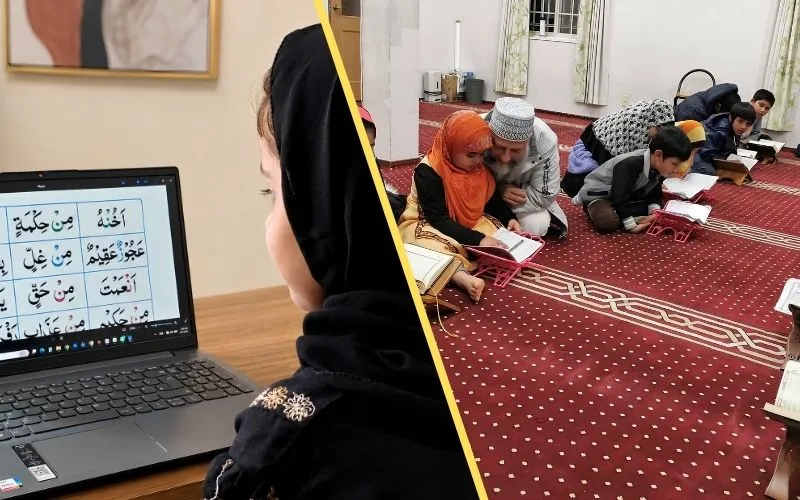
Online Quran classes generally offer more one-on-one attention and flexible scheduling, while local masjid classes offer in-person community and, for some children, an easier transition into regular mosque life. Neither is universally “better” — the right choice depends on what’s actually available near you, how your child learns best, and what your family’s schedule realistically allows.
If you’ve been going back and forth on this, here’s an honest side-by-side, without pretending one option has no downsides.
Attention and Class Size
Local masjid classes are often taught in groups, sometimes 10-20 children with one teacher. That works well for children who thrive in a classroom setting and learn from watching peers, but it also means less individual correction. A child who’s shy about making mistakes in front of a group, or who needs a slower pace than the rest of the class, can quietly fall behind without anyone noticing right away.
Online classes are typically one-on-one, so every minute of the lesson is focused on your child specifically. The tradeoff is that some children genuinely benefit from the social element of learning alongside peers, which a one-on-one online class doesn’t replicate.
Availability and Waitlists
This is where online classes have a clear practical advantage for many families. Even in cities with an established Muslim community, popular masjid Quran programs often have waitlists, especially for younger age groups or for female teachers. Families in smaller towns or suburbs may not have a local program at all.
Online classes remove this constraint. You’re not limited to teachers within driving distance, which also means access to specialists — a teacher known specifically for Tajweed, or a female teacher for your daughter — rather than whoever happens to be available locally.
Cost
This varies too much by location and program to generalize cleanly. Some masjid programs are low-cost or donation-based, run largely by volunteers. Others, especially those with paid, formally trained teachers, cost comparably to or more than online options. It’s worth actually comparing real numbers for your specific area rather than assuming one is automatically cheaper.
Schedule Flexibility
Masjid classes usually run on a fixed weekly schedule set by the mosque, often clustered around after-school hours when many other things compete for a child’s time (homework, sports, family commitments). If that slot doesn’t work for your family, there’s often no alternative time offered.
Online classes can usually be scheduled around your actual week, including evenings and weekends, and rescheduled if something comes up. For busy or non-standard family schedules, this flexibility often matters more than it initially seems.
Community and In-Person Connection
This is the one area where local masjid classes have a real, distinct advantage that online classes can’t fully replace. Children who attend classes at the masjid are physically present in a place of worship regularly, see other Muslim families and children their age, and build a sense of belonging to a local community that happens naturally through repeated in-person presence.
If your child already has strong community connection through Friday prayers, Eid gatherings, or other regular mosque involvement, this gap matters less. If your family’s only real point of contact with a local Muslim community would be through Quran class specifically, it’s worth weighing this seriously rather than dismissing it.
Consistency When Life Gets Busy
Masjid classes typically don’t offer make-up sessions if a child misses a week, since the group moves forward together regardless. Online classes, especially one-on-one ones, can usually accommodate a missed session with a reschedule, since there’s no group pace to keep up with.
So Which Should You Choose?
If a well-run local program is genuinely accessible near you, with a schedule that fits and a teacher your family is comfortable with, it’s a strong option, particularly for the community connection it offers. If access, scheduling, or finding the right fit (like a qualified female teacher or a Tajweed specialist) has been the sticking point, online Quran classes solve exactly that problem, without requiring you to give up structure or accountability.
Many families end up combining both: online Quran classes for structured, one-on-one Quran learning, alongside regular masjid attendance for community and congregational prayer. The two aren’t mutually exclusive.
Frequently Asked Questions
Is online Quran learning as effective as attending a masjid class? For recitation, Tajweed, and memorization specifically, one-on-one online instruction often allows for more individualized correction than a group masjid class. What online classes don’t replace is the in-person community aspect of regularly attending the masjid.
Should I choose online classes if there’s a masjid class available near me? Not necessarily — it depends on class size, the teacher’s fit for your child, and whether the schedule works for your family. A crowded group class with a rigid schedule may be a weaker fit than a well-matched online teacher, even if the masjid option is geographically closer.
Can my child do both online Quran classes and attend the masjid? Yes, and many families do exactly this — online classes for structured, individual Quran instruction, and regular masjid attendance for community, congregational prayer, and social connection.
What if my child struggles in a group masjid class but I want them to have community connection too? Online one-on-one classes can address the learning gap, while continuing regular masjid attendance separately (for prayers, Eid, community events) can still provide the community connection, without those two needs having to be met by the exact same program.